Storytelling as Commodity: The Antipodes
A Cultural Critique.
Annie Baker’s 2018 play The Antipodes delivers a clever critique on creative industries and the commercialisation of storytelling. It is not surprising that as the market value of storytelling industries like film, TV, theatre, and publishing grows, stories are increasingly tailored to fit audience expectations. We have the world’s greatest films and novels at our fingertips in an instant if we want to. As part of this audience, we cannot deny how this rise in access has fundamentally changed our lives. It has changed how often we engage with media and thereby changed what we expect from it as frequent consumers. A growing market means more media is being created for consumers. The biggest and most captivating stories are invested in and pushed towards audiences, we learn new things, culture changes, and we inevitably understand each other and humanity at large a little bit better. Right?
Through The Antipodes, Annie Baker critiques the commodification of storytelling within creative industries, exposing how capitalist markets exploit personal experiences, prioritise profitability over artistic depth, and reinforces cultural gatekeeping.
In my interpretation of Annie Baker’s play, she captures the new elitism of the storytelling industries and showcases how the industry operates behind the walls, or perhaps, how the market feels to emerging storytellers.
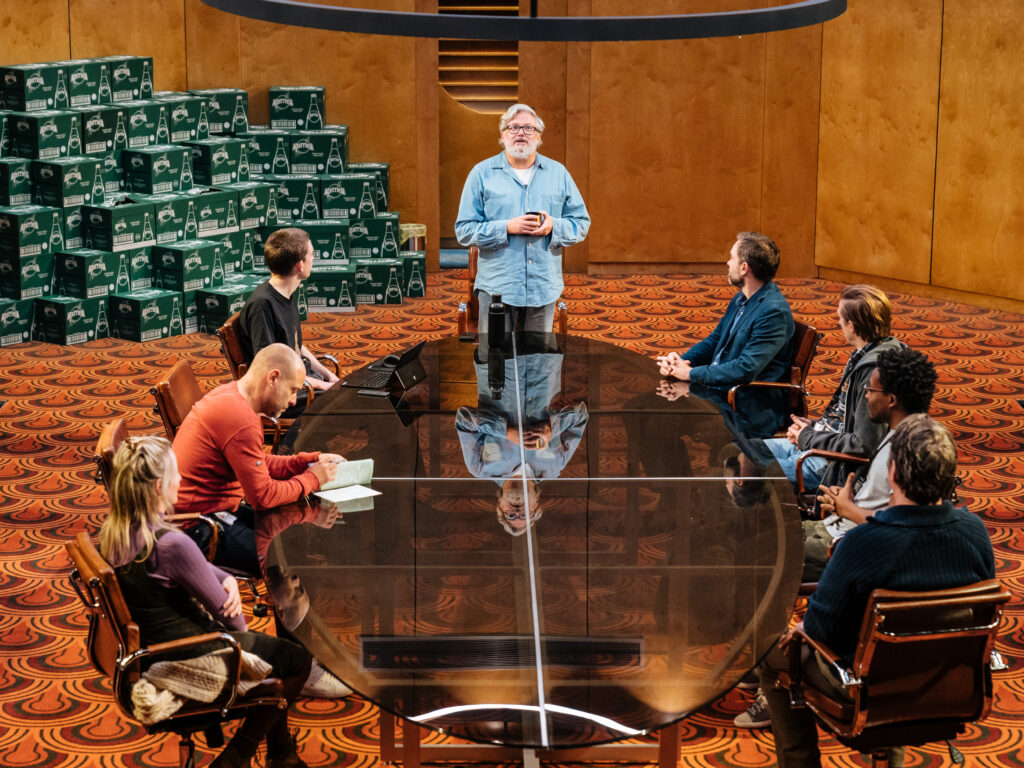
The play follows a group of people in a corporate setting who are trying to come up with an idea for a story. What the idea is for is never specified. It could be for a movie, a tv show, a play, a comic etc. The play is set in a meeting room around a large table. It jumps from section to section, creating a dreamlike effect which contributes to the disintegration into an absurd mess – Which is where the play eventually heads. They begin by brainstorming different ideas, but as they struggle to come up with something that’s deemed good enough for their boss Sandy, they begin telling stories from their own lives in an attempt to inspire something. They dig into traumas, worries and embarrassments, exposing their vulnerabilities in order to satisfy the industry they work for. Eventually, it spirals deep into a confused mix of philosophical details which they try manifesting into some sort of narrative. When they finally come up with something they can agree on, Sandy shows up and announces that the project has been cancelled. He justifies this by saying that there are ‘no more stories’, declaring it the end of an era. He also adds that ‘this is the worst possible time in the history of the world to be telling stories.’ (Baker, 2018, p. 82).
The play is peppered with uncertainty. No idea is good enough and they continue searching for the ultimate idea. The struggle to produce something that’s deemed ‘good enough’ eventually leads to an exploitation of personal stories. The Antipodes can be read as offering a critique on storytelling industries.
Stories have in some ways become a commodity for an increasingly capitalist market. There’s a drive by industries to create products that are consumer-friendly and attention-grabbing. Similarly to engineered food, stories are being designed to be easily consumed and palatable but might lack in quality. A few examples are Hollywood for film, Misery Memoirs for publishing, and The West End or Broadway for theatre. As consumers, we are having to do less work to interpret and understand the media we are consuming. Stories as a commodity are tailored by media companies to appeal to a mass audience. For companies like these, profit is crucial in order to keep existing. Catering to the audience is therefore, arguably, in everyone’s best interest to a certain extent. However, the extent to which the industry is willing to go in order to make a profit can lead to exploitation of real human experiences and stories.
The commodification of suffering from personal stories is very well exemplified through the genre of Misery Memoirs. Misery Memoirs have risen to popularity in recent years due to an increased interest in reading about other people’s personal and traumatic events. According to Rothe, the worse the accounts, the better it sells, with sales in the autobiographical category having risen from $170 to $270 million since 1999. (Rothe, 2011, p. 90). In fact, ‘the two largest British bookstore chains, Waterstones and W. H. Smith have each created a special shelf category with Waterstones opting for “Painful Lives” and W. H. Smith for “Tragic Life Stories”’. (Rothe, 2011, p. 90). The commodification of trauma is evidently encouraged by corporations and business, if it generates revenue. This is further problematised by corporations going to such lengths as to exploit accounts of injustice for revenue.
In an article for the New Socialist (2022), the writer Javdani explains how a previous article of hers about workplace disempowerment was given a title which reduced her experience to being about her nationality, even though the content of the article was about how nationality should not be the focus in the workplace. The title, which was chosen by the editor, was meant to draw attention to Javdani’s article, but instead it put her in a disempowering position while simultaneously misrepresenting the content of her article. To this Javdani responds, ‘If I refuse to participate in my own commodification, my work remains unpaid and under-appreciated. It’s a clever trick that keeps marginalised people invested in the systems that actively oppress them.’ (Javdani, 2022). Javdani eventually allowed the article to be published, later on realising that she had let her experience be misrepresented and commodified for the business she was working for. For this reason, she chooses not to share the name of the article.
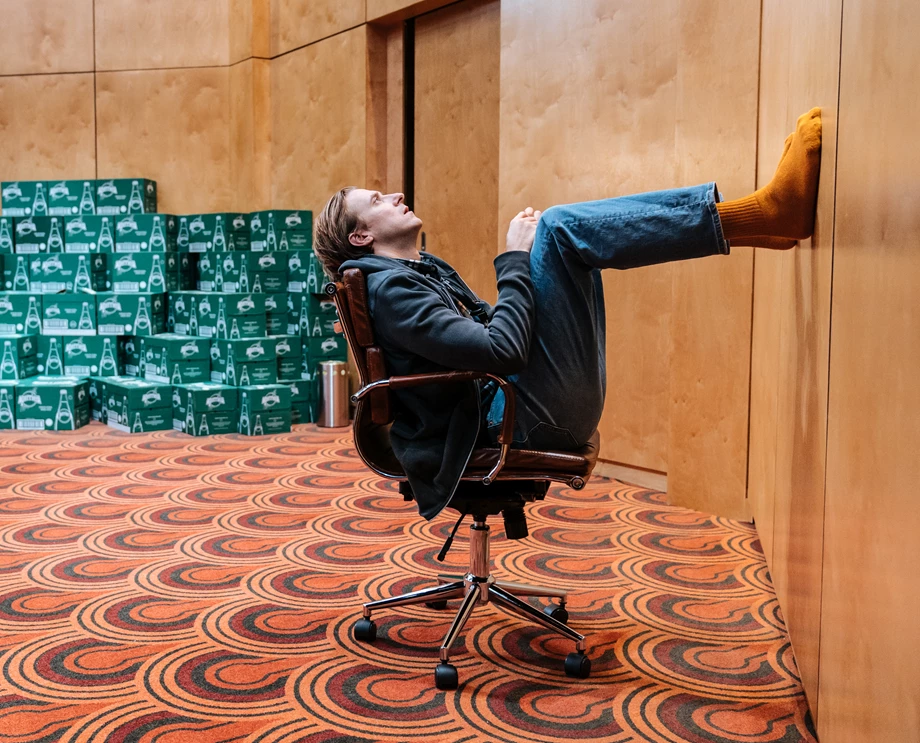
In The Antipodes (2018), the hypocrisy of the business is not immediately noticeable, but there is an underlying sense of competition for Sandy’s approval. As Sandy is introducing his principles to the new employees, he gives a speech about what the newcomers can expect from the work environment. He states that ‘he doesn’t fire people unless they’re complete assholes’ (Baker, 2018, p. 15). At various points, he encourages rounds of confessions about abuse, sexual relations and familial tragedies. Sandy listens to all the suggestions but never shows interest in using any of it. Another central character Danny tells a story about how he was scared to hold a chicken on a farm when he was a teenager, and therefore he never picked up the chicken. The others are confused as to why that story would be embarrassing, but he allocates a deeper significance to the experience when he says, ‘I feel like if I had just picked up the chicken something would have changed in me and my life might be very different now.’ (Baker, 2018, p. 40). Danny is getting at the underlying anxiety-inducing feeling of missed opportunity. He is met with silence, but adds that, 1. Telling personal stories feels fake and misleading. 2. That the way they see him is not the way he actually is. 3. That he never wanted to turn his personal life into a story. Danny is asked to meet Sandy in his office. Afterwards, he is never seen again in the play, insinuating that he got fired. Although all he did was tell his own truth, which unintentionally exposed the hypocrisy of a work environment looking for something real, but apparently not ‘too real’.
Alongside film and publishing, theatre as an artform is also overshadowed by market-driven priorities. The theatre industry is not exempt from commodifying art for profit. Big theatre industries exemplify what this dynamic might look like. The West End theatres in London and Broadway in New York are examples of commercial theatre as we know it. They stage shows that have been running for years, with plays like The Mousetrap by Agatha Christie which has been running since 1952. Or The Woman in Black by Susan Hill which has been running since 1989. (Wikipedia, 2025). In the UK, the West End Theatres generate the biggest revenue for the theatre industry, having gained a gross revenue of almost £900,000,000 in 2022. Going to a West End show has become its own tourist attraction, ‘In 2019, International visitors accounted for 50% of all spending.’ (Tyrrell, 2022). There is still a sea of standalone underground theatres putting on contemporary plays and performing new and emerging dramas, but these are usually underfunded or non-profits run by people with a passion for performance art.
The growth of commercial theatre and its popularisation eventually leads to the industry platforming bigger names, with famous screen actors often appearing on stage. The heightened prestige of the business leads to an industry that gatekeeps the art, making it difficult for new and upcoming actors and dramatists to get a foot in the door. This is a multifaceted issue, as a high interest in theatre is a good thing for the artform. However, big theatres only platforming certain stories, allows for less diversity and consequently important and unique stories rarely reach the masses.
Fringe theatre companies often stage personal stories, and most of the emerging dramas happen in these theatres. But often when these shows gain commercial attention, their narratives are stripped of nuance to appeal to mainstream audiences. For instance, the play For Black Boys Who Have Considered Suicide When the Hue Gets Too Heavy by Ryan Cameron (Cameron, 2021) transitioned to the West End in 2023. While this move brought visibility, critics argue that mainstream producers capitalise on such narratives without fostering opportunities for marginalised creators (Edwardes, 2024). Instead of supporting theatres organised by marginalised groups, industries will borrow those stories to generate further revenue for themselves, which perpetuates the same systems those stories are directly arguing against.
Theatre has for centuries been an elitist artform only afforded by the upper classes. It is only in the last 50 years that theatre has been commercialised. In the 1980s there were ‘pressures which aimed to make theatre more market and consumer oriented’. There was a push to ‘undermine elitism by populism’, and therefore a move from an ‘essentialist to an instrumentalist view of the function of theatre in society’. (Kershaw, 1994, p.156). Theatre had previously been protected from the market forces to ensure that no state interference was tampering with the art form. Because as stated by the ACGB, ‘art puts people in touch with “universal” values, so it should be protected both from market forces and state interference since it’s an essential ingredient in the satisfied citizen’s life.’ (Kershaw, 1994, p. 157). But as the reforms of the Thatcher government demanded greater ‘value for money’ in public institutions, the Arts Council shifted to a more populist stance and changed their ‘arm’s length principle’, which aimed to prevent state interference in the freedom of the arts. (Kershaw, 1994, p. 157).
The commercialisation of theatre has thus transformed the art into what we can now describe as a commodity: a market-responsive industry. We are inevitably left with an industry that profits on theatre as a commercial commodity, with limited stories being platformed. Thereby, the artform has lost some of its depth and prestige. Theatre went from being a high art only afforded by the elite – to becoming accessible to the middle classes – to what we have now: commercial theatre that can be enjoyed by everyone willing to spend some money on it. But the industry behind has yet again become elitist, exclusionary, and closed off to newcomers in their approach.
We can expect that stories will become even more commodified or artificially engineered to cater to mainstream audiences. It’s also briefly worth mentioning that the rise of AI introduces an unresolved threat to the arts. Stories lose their art when reduced to algorithms. The human artist could be replaced by a ‘perfect formula’, but we can expect that this shift would be driven mainly by companies tailoring their stories to the masses for easer consumption. This incentivises companies to be selective of what kinds of stories are being platformed and therefore, the quality of the art is compromised by its profitability.
Although the commodification of stories continues within the various artforms, theatre as a form might be uniquely exempt from the increasing commodification. The very nature of how theatre and performance operate as an interaction between humans, sets it apart from other digitalised mediums. Theatre’s exemption from commodification lies in its ‘unique and ephemeral qualities’ which means the performer produces a pure use-value, because the performance has no equivalent, even in its own repetition. (Kershaw, 1994, p. 171). In live performance, the audience is reacting to the performers on stage. The performers are in turn reacting to the audience, which changes the outcome of the performance. It becomes an interaction between people rather than a product for consumption. It’s a live event, where the audience has agreed to be in a certain space at a certain time. They have agreed to lend their attention, and therefore their imagination to the performance and its signifiers.
The audience fills in the blanks, ‘The signs produced by the performer invite the audience to attend to what is absent, and in doing so they become ‘co-producers rather than consumers.’ (Kershaw, 1994, p. 171). Theatre provides a space for enhanced authority of the ‘consumer’. The human interaction which exists and is encouraged at the point of sale of the commodity, keeps theatre from becoming a cold commodification. The artform is in itself a conversation between people. The problem, however, still remains in how the industry operates, gatekeeps, prioritises what gets platformed, and how it influences culture by inherently capitalistic means.
The Antipodes (Baker, 2018) highlights how the industry exploits personal stories or systems of oppression, and reduces them to tropes that can be sold as a commodity for profit, without contributing any real solutions to the problem. The play asks what kinds of stories should be prioritised and platformed. If Danny’s reflection on a true experience is not good enough, then what is? His statements highlight how the industry encourages and prioritises shallow and cheap entertainment over intellectual depth.
Bibliography
Akbar, A. (2025) ‘Tarantula review – extraordinary portrayal of the aftermath of senseless violence’. The Guardian, 12 January [Online]. Available at: https://www.theguardian.com/stage/2025/jan/12/tarantula-review-extraordinary-portrayal-of-the-aftermath-of-senseless-vi
olence (Accessed: 18 January 2025).
Baker, A. (2013) The Flick. London: Nick Hern Books.
Baker, A. (2015) John. London: Nick Hern Books.
Baker, A. (2018) The Antipodes. London: Nick Hern Books.
Cameron, R. C. (2021) For Black Boys Who Have Considered Suicide When the Hue Gets Too Heavy. London: Bloomsbury Academic.
Clark, E. (2023) ‘The End Of Originality: Is AI Replacing Real Artists?’. Forbes, 26 December [Online]. Available at: https://www.forbes.com/sites/elijahclark/2023/12/23/the-end-of-originality-is-ai-replacing-real-artists/ (Accessed: 5 January 2025).
Edwards, J. (2024) ‘For Black Boys Who Have Considered Suicide When the Hue Gets Too Heavy, Garrick Theatre review – exhilarating, moving show makes West End return’. The Arts Desk, 09 March [Online]. Available at: https://theartsdesk.com/theatre/black-boys-who-have-considered-suicide-when-hue-gets-too-heavy-garrick-theatre-review (Accessed: 15 January 2025).
Javdani, S. (2022) ‘The Commodification of Trauma’. New Socialist, 17 August [Online]. Available at: https://newsocialist.org.uk/transmissions/the-commodification-of-trauma/ (Accessed: 7 January 2025).
Kershaw, B. (1994) ‘Framing the audience for theatre’, et al. (eds.) The Authority of the Consumer. London; New York, NY: Routledge, pp. 154-171.
‘List of the longest-running West End shows’ (2025) Wikipedia [Online]. Available at: https://en.wikipedia.org/wiki/List_of_the_longest-running_West_End_shows (Accessed: 15 January 2025).
Rothe, A. (2011) Popular Trauma Culture: Selling the Pain of Others in the Mass Media. New Brunswick: Rutgers University Press.
Society of London Theatre. (2023) Data & Research [Online]. Available at: https://solt.co.uk/data-and-research/ (Accessed: 10 January 2025).
Tyrrell, J. (2022) Submission to the DCMC Select Committee by New West End Company [Online]. Available at: https://committees.parliament.uk/writtenevidence/42129/pdf/#:~:text=In%202019%2C%20International%20visitors%20accounted,to%20over%20%C2%A35%20billion (Accessed: 10 January 2025).
Waite, S. (2024) ‘Review: Spent (Baron’s Court Theatre)’, All That Dazzles, 12 November [Online]. Available at: https://www.allthatdazzles.co.uk/post/review-spent-baron-s-court-theatre (Accessed: 15 January 2025).
Wiegand, C. (2024) ‘Bridgerton’s Jonathan Bailey to play Richard II on London stage’. The Guardian, 21 June [Online]. Available at: https://www.theguardian.com/stage/article/2024/jun/21/jonathan-bailey-richard-ii-nicholas-hytner-bridge-theatre-bridgerton (Accessed: 10 January 2025).
Wiegand, C. (2024) ‘Ewan McGregor returns to the West End in new play My Master Builder’. The Guardian, 3 December [Online]. Available at: https://www.theguardian.com/stage/2024/dec/03/ewan-mcgregor-west-end-new-play-my-master-builder-by-lila-raicek-michael-grandage (Accessed: 10 January 2025).